

There is a kind of power that doesn’t announce itself. It doesn’t raise its voice, clench its fists, or issue ultimatums. It moves quietly through a glance, a withdrawal, a perfectly timed tear. Understanding it isn’t about fear or suspicion. It’s about self-awareness.
Feminine energy, at its best, is magnetic, nurturing, and deeply intelligent. But like every form of power, it has a shadow side, one that psychology has studied for decades under the lens of emotional manipulation, covert narcissism, and what is increasingly known as dark feminine psychology. This article isn’t a manifesto against women. It is a guide for men who want to understand themselves better, recognize harmful dynamics early, and build relationships rooted in honesty rather than control.
By the end of this guide, you’ll understand the core dark feminine psychology tactics, the psychological reasons men are vulnerable to them, and, most importantly, how to protect yourself without becoming bitter or closed off.
Table of Contents
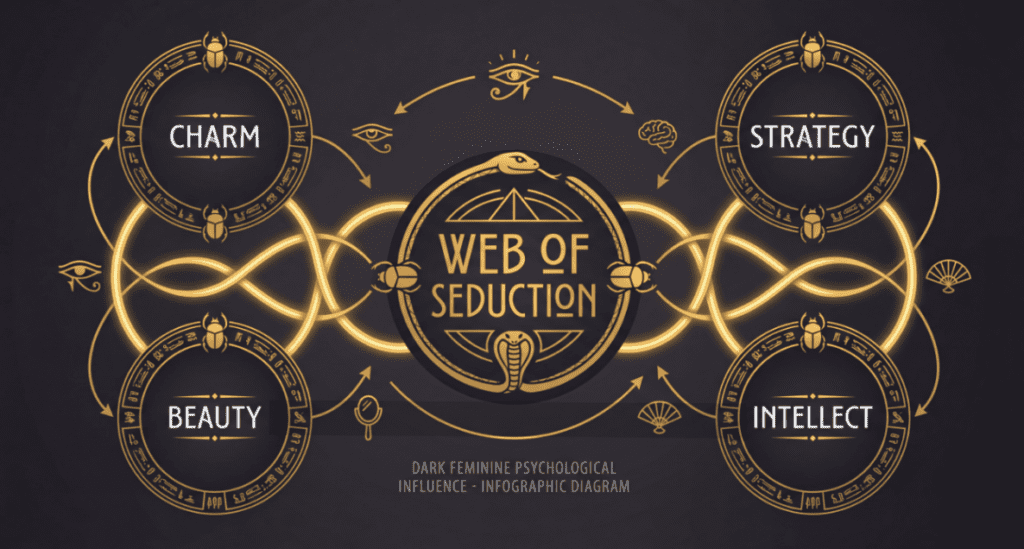
What Is Dark Feminine Psychology?
Dark feminine psychology refers to the deliberate, and often highly conscious, use of emotional, social, and psychological tools to control, influence, or manipulate others, typically for personal gain. It draws on the full arsenal of emotional intelligence: empathy weaponized as guilt, vulnerability performed as leverage, and charm deployed as a trap.
It is critical to make a distinction here. Healthy feminine assertiveness, setting boundaries, expressing needs clearly, using emotional intelligence to connect, is not only normal but admirable. What we’re examining is something different: the weaponization of those same traits.
Psychologists identify several overlapping frameworks that explain this behavior pattern:
- Emotional manipulation: The use of another person’s emotions against them to achieve a desired outcome
- Covert narcissism: A quieter, more subtle form of narcissistic personality disorder in which the individual appears vulnerable or victimized while actually exerting significant control
- Machiavellianism: A personality trait defined by strategic thinking, emotional detachment, and a willingness to manipulate others to achieve goals
According to the Dark Triad model, studied extensively in personality psychology, Machiavellianism, narcissism, and psychopathy can manifest in anyone regardless of gender, but their expression often differs. In women, research suggests these traits more frequently manifest through relational and emotional channels rather than overt aggression.
“Emotional manipulation is not always loud. Often, the most effective forms of control are invisible, felt but never named.” — Verywell Mind, 2026
“7 Signs of Emotional Manipulation in Relationships” — Verywell Mind
Understanding this is the first step toward immunity.
The 7 Core Dark Emotional Manipulation Tactics
These tactics are not theoretical abstractions. They show up in real relationships, often gradually, until the target no longer recognizes himself in the mirror.
1. Emotional Flooding
This tactic involves overwhelming a partner with intense emotional outbursts, crying, rage, despair, specifically designed to short-circuit his rational thinking. When a man is flooded with someone else’s emotions, his logical faculties go offline. He stops asking “Is this fair?” and starts asking “How do I make this stop?” Decisions made in this state almost always benefit the manipulator.
2. Guilt-Tripping
Guilt is one of the most effective levers in human psychology. A skilled manipulator doesn’t need to threaten you, she simply needs to make you feel responsible for her pain. Phrases like “After everything I’ve done for you…” or “I guess I just don’t matter to you” are designed to trigger your protective instincts and redirect your behavior without a single direct demand.
3. Silent Treatment / Cold Shoulder
Weaponized withdrawal is a form of emotional punishment. By suddenly going cold, no texts, no eye contact, no warmth, the manipulator creates an anxiety vacuum that the target rushes to fill. The implicit message is clear: comply, apologize, or lose my affection. Over time, this conditions a man to walk on eggshells permanently.
4. Love Bombing Then Withholding
This is one of the most psychologically destructive tactics. It begins with an overwhelming surge of affection, attention, and validation, the love bomb. Then, without warning, it is withdrawn. The resulting emotional whiplash creates a powerful craving for the high of the early phase, making the target increasingly willing to do anything to get it back. This is the foundation of trauma bonding.
5. Victimhood Projection
In this pattern, the manipulator positions herself as the perpetual victim, of circumstances, of past relationships, of your behavior. This framing is powerful because it preemptively disarms any criticism. If she is always the victim, you are always the aggressor. Any attempt to hold her accountable becomes “attacking” her. Any boundary you set becomes “abandonment.”
6. Jealousy Induction
By casually mentioning other men’s interest, maintaining ambiguous friendships, or behaving in ways designed to provoke insecurity, a manipulator keeps her partner in a constant state of low-grade anxiety. This anxiety binds him to the relationship, he’s too busy competing for her attention to notice he’s being controlled.
7. Gaslighting
Perhaps the most psychologically damaging tactic of all. Gaslighting involves systematically undermining a person’s perception of reality. “That never happened.” “You’re too sensitive.” “You’re imagining things.” Over time, the target begins to distrust his own memory, instincts, and judgment, making him entirely dependent on the manipulator’s version of reality.
📊 1 in 3 adults reports experiencing emotional manipulation in a romantic relationship, Emotional manipulation prevalence
The Cleopatra Archetype: Seduction as a Weapon
History’s most iconic example of feminine psychological power is Cleopatra VII of Egypt. She was not merely beautiful, she was a polyglot who spoke nine languages, a political strategist who seduced two of Rome’s most powerful men (Julius Caesar and Mark Antony) not by accident, but by design. She understood that charm, intellect, emotional mirroring, and carefully curated vulnerability were weapons more powerful than any army.
The Cleopatra Archetype in modern dark feminine psychology describes a woman who combines:
Charm and beauty as opening moves to lower defenses
Intellectual mirroring: reflecting back your values, interests, and worldview to create an illusion of perfect compatibility
Emotional intelligence deployed not for connection, but for leverage
Future-faking: painting vivid pictures of a shared future to create emotional investment before the manipulation begins
Signs You’re Dealing with the Cleopatra Archetype
She seems too perfect, too aligned with everything you value, almost as if she researched you.
Excessive flattery arrives early and feels slightly performative
She references “your future together” unusually quickly
You feel a magnetic pull that seems disproportionate to how long you’ve known her
She is acutely aware of her effect on you and uses it consciously
“The most dangerous seductress is not the one who relies on beauty alone, but the one who uses your own desires as the bait.” — Psychology Today
The Cleopatra Archetype is not inherently malicious, strategic intelligence and charm are neutral traits. The red flag is when they are deployed without reciprocal authenticity, purely as tools of influence and control.
Emotional Dependency: How It’s Built and Maintained
Understanding the mechanics of emotional dependency is essential to recognizing when you’re caught in it.
The Intermittent Reinforcement Cycle
Psychologists have long known that intermittent reinforcement, rewards given unpredictably, creates the strongest and most resistant behavioral conditioning. It’s the same mechanism behind slot machines. When affection and approval are given randomly rather than consistently, the brain becomes obsessed with obtaining the next “hit.”
The cycle works like this:
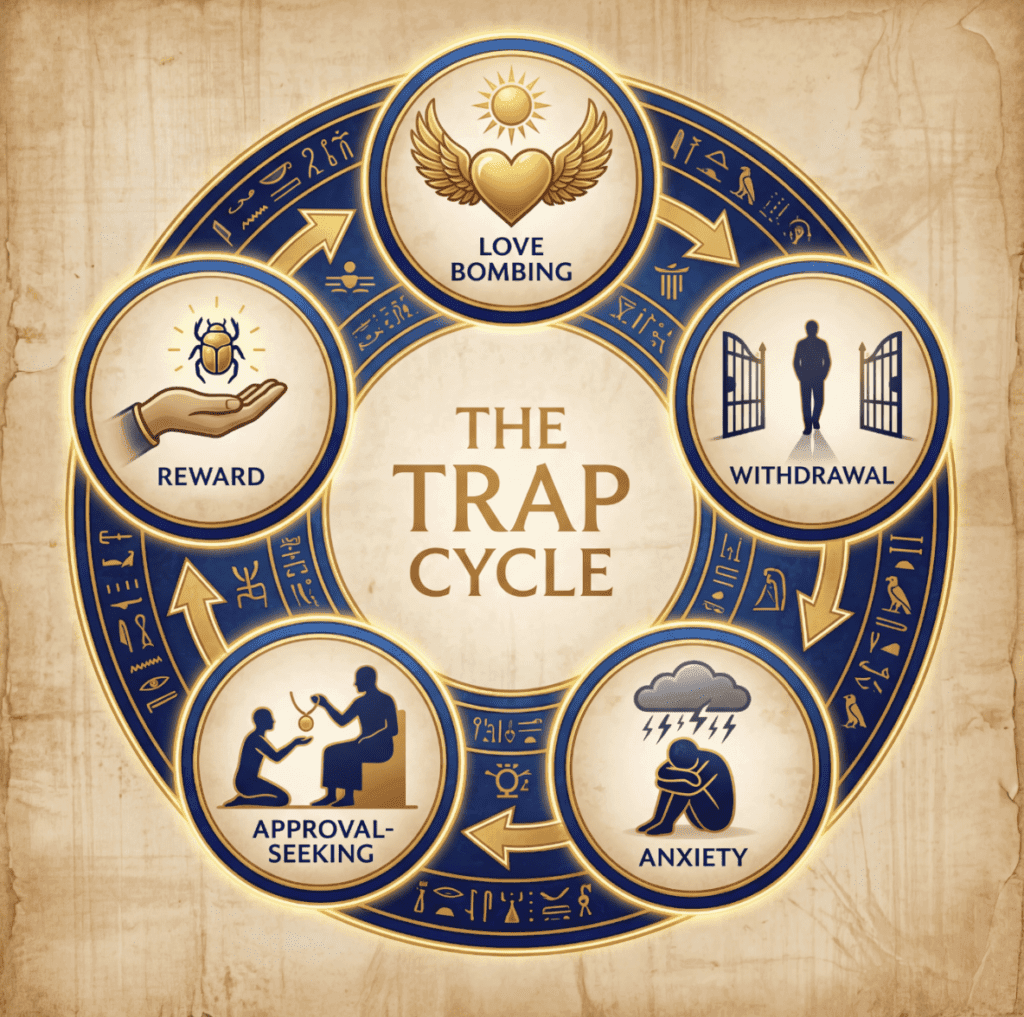
This cycle, when sustained over months or years, creates what psychologists call a trauma bond, an attachment that is paradoxically strengthened by the pain it causes. The man in this cycle isn’t weak; he’s been neurologically conditioned.
Warning Signs You’re Already Emotionally Dependent
You think about her constantly, even when things are “good”
Your mood is entirely dictated by her behavior toward you
You’ve abandoned hobbies, friendships, or goals to keep the peace
The idea of leaving fills you with disproportionate terror
You feel more relief than joy when she’s kind to you
📊 74% of people in emotionally abusive relationships report difficulty leaving due to psychological dependency — Trauma bonding impact
Read this article: “You’re Too Sensitive” Is Code for Her Toxic Truth
Dark Feminine Psychology: 10 Red Flags You Should Never Ignore
These are the 10 toxic relationship red flags that should stop you in your tracks. If you recognize three or more of these, it’s time to take the situation seriously.
✅ She consistently dismisses your feelings but expects, and demands, full validation of hers
✅ You feel like you’re constantly “walking on eggshells”, monitoring your words, tone, and behavior to avoid her reactions
✅ Your self-esteem has noticeably dropped since the relationship began; you feel less confident, less capable
✅ Sex or affection is used as a reward/punishment system, withheld when you displease her, offered when you comply
✅ You feel confused, guilty, or “crazy”, but can’t pinpoint exactly why or what you did wrong
✅ People close to you have noticed changes, friends or family comment that you seem different, withdrawn, or unlike yourself
✅ She has gradually isolated you from your support network, subtly discouraging friendships or creating conflict with people you trust
✅ You apologize constantly, even in situations where you know, rationally, that you are not at fault
✅ Her stories about past relationships are always the same, she is always the victim, her exes are always “crazy” or “abusive”
✅ You feel responsible for her emotional regulation, as if her happiness or stability depends entirely on your behavior
According to a 2025 report by TODAY.com, relationship experts emphasize that a consistent pattern of feeling “less than” in a relationship is one of the strongest predictors of emotional abuse, regardless of whether physical violence is present.“20 Relationship Red Flags You Should Never Ignore” — TODAY.com
The Psychology Behind Why Men Fall for It
Understanding why men are vulnerable to these psychological manipulation signs is not about assigning blame, it’s about building genuine self-awareness.
Evolutionary Wiring: The Protector-Provider Drive
Men are, on an evolutionary level, wired to protect and provide. A woman who signals vulnerability, real or performed, activates this drive powerfully. Manipulators who deploy victimhood or emotional fragility are, consciously or not, exploiting one of the deepest masculine instincts.
Attachment Theory: The Anxious Attachment Trap
Men with anxious attachment styles, typically formed in childhood through inconsistent caregiving, are significantly more vulnerable to intermittent reinforcement cycles. The hot-and-cold dynamic of a manipulative relationship mirrors the emotional inconsistency of their early attachment experience, making it feel familiar rather than alarming.
Social Conditioning: “Don’t Quit”
Men are culturally conditioned to persist, to fix problems, and to not “give up” on relationships. This conditioning is largely positive in healthy contexts, but in a toxic dynamic, it becomes a trap. The man who stays and “works harder” is often rewarded not with a better relationship, but with deeper entanglement.
Ego and Masculine Identity
For many men, the relationship becomes tied to identity. Admitting that you’re being manipulated feels like admitting weakness. This pride, entirely understandable, is itself a vulnerability that skilled manipulators exploit. The harder it is for you to admit something is wrong, the longer the manipulation can continue undetected.
📊 Men are 40% less likely than women to identify emotional manipulation in their own relationships — Male vulnerability to emotional manipulation
How to Protect Yourself: Building Psychological Armor
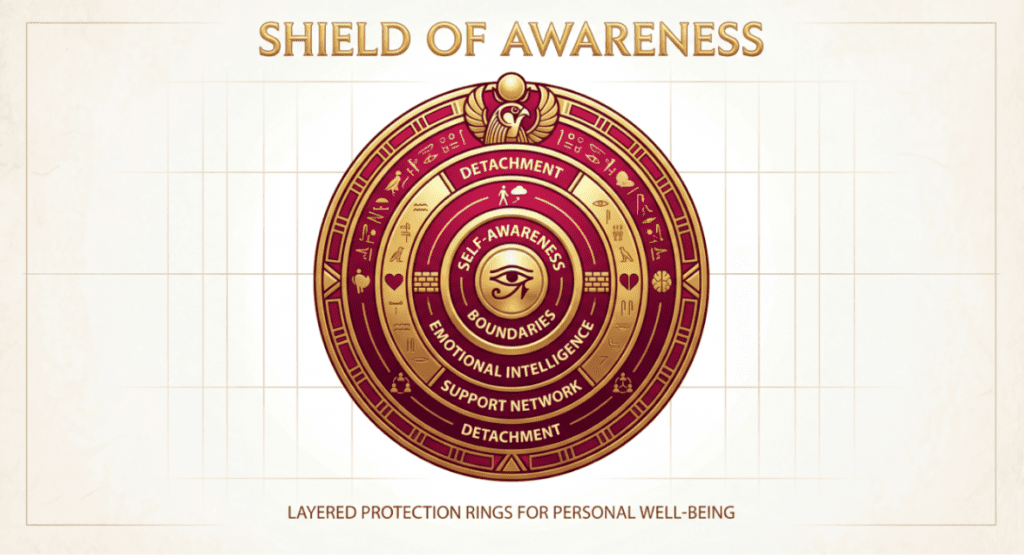
Protection doesn’t mean becoming cold, suspicious, or closed. It means becoming grounded, so rooted in your own reality that manipulation struggles to find purchase.
1. Develop Self-Awareness
The single most powerful defense against manipulation is knowing yourself. Know your emotional triggers, your attachment patterns, your insecurities. A manipulator can only pull strings that are already there. Journaling, therapy, and honest self-reflection are not signs of weakness, they are the foundation of psychological strength.
2. Set and Enforce Non-Negotiable Boundaries
Boundaries are not walls, they are the terms under which you are willing to engage. Identify your non-negotiables early and enforce them consistently. A person who respects you will respect your limits. A manipulator will immediately test, challenge, and attempt to erode them.
3. Trust Your Gut: Validate Your Own Perception
Gaslighting works because it makes you doubt yourself. Practice trusting your instincts. If something feels wrong, it probably is. You don’t need her confirmation that your perception is valid, you are allowed to trust your own experience.
4. Build a Strong Male Support Network
Isolation is a key tool of manipulation. Maintaining strong friendships and connections with men you trust creates a reality check system. When the people who know you best express concern, take it seriously.
5. Use Therapy, Journaling, and Mindfulness
These are not trendy buzzwords, they are evidence-based tools for building the emotional resilience that makes manipulation ineffective. A therapist who specializes in relational psychology can help you identify patterns before they become entrenched.
6. Know When to Walk Away
This is perhaps the hardest skill to develop, but the most important. Walking away from a relationship that diminishes you is not failure, it is an act of profound self-respect. The sunk cost fallacy (“I’ve invested so much”) is not a reason to stay. Your future is not determined by your past investment.
Healing After Manipulation: Reclaiming Your Power
If you’ve been in a manipulative relationship, the aftermath is real and significant. Shame, confusion, self-doubt, and a distorted sense of reality are common, and they are not a reflection of your intelligence or strength. They are the predictable result of sustained psychological pressure.
Acknowledge the Damage Without Shame
The first step is naming what happened. Not to assign blame, but to see clearly. Many men struggle to identify their experience as manipulation because it contradicts the self-image of someone in control. Let that go. Clarity is more valuable than pride.
Steps to Recovery
No contact (or minimal contact): Distance is essential for the nervous system to reset. The cycle cannot continue if you remove yourself from it.
Seek professional support: A therapist experienced in trauma bonding and emotional abuse can dramatically accelerate recovery.
Rebuild your identity: Reconnect with the hobbies, friendships, and goals that defined you before the relationship. Reconstruct the self that was gradually dismantled.
Reframe the experience: This is not a story of weakness. It is a masterclass in human psychology that you paid for with your time and emotional energy. Use the knowledge.
Set a new standard: Use the experience to clarify what you will and will not accept in future relationships. Healthy love does not require you to shrink.
“Recovery from emotional manipulation is not about becoming harder, it’s about becoming wiser. The goal is not to trust less, but to see more clearly.” — Psychology Today
The goal is not to emerge from this experience cynical or closed. It is to emerge whole, with a clearer understanding of yourself, your patterns, and the kind of partnership that actually serves your growth.
Conclusion: Awareness Is Your Greatest Weapon
Dark feminine psychology is not a myth, a conspiracy, or an excuse for misogyny. It is a documented set of behavioral patterns, rooted in psychology, attachment theory, and the darker expressions of the Dark Triad, that can cause real harm to real people.
This article is not about hating women. It is about knowing yourself well enough that manipulation, from anyone, cannot easily take root. A man who understands emotional flooding, trauma bonding, gaslighting, and the Cleopatra Archetype is not a suspicious, closed-off man. He is a self-aware man — capable of genuine intimacy precisely because he is no longer driven by unconscious vulnerabilities.
The most powerful thing you can do is stay curious about your own psychology. Read, reflect, build your emotional intelligence, and surround yourself with people who know and respect the real you.
If this article opened your eyes, share it with a man in your life who might need to read it. The conversation about emotional manipulation in relationships is one we need to have more openly, and more honestly.
— Cleopatra, the author who reveals The Female Hidden Manipulation Tactics.
Frequently Asked Questions (FAQ)
What exactly is dark feminine psychology?
Dark feminine psychology refers to the use of emotional, social, and psychological tactics, such as guilt-tripping, gaslighting, love bombing, and emotional withdrawal to control or manipulate others. It is not a characteristic of all women, but rather a specific pattern of behavior associated with traits like covert narcissism and Machiavellianism. Understanding it is about self-protection and awareness, not gender conflict.
How can I tell if I’m being emotionally manipulated in a relationship?
Key signs include: constantly feeling confused or guilty without a clear reason, walking on eggshells around your partner, noticing your self-esteem has declined since the relationship began, feeling like affection is used as a reward or punishment, and having friends or family express concern about changes in your behavior. If three or more of these apply consistently, it’s worth examining the dynamic closely.
Can men recover from a manipulative relationship?
Absolutely — and fully. Recovery typically involves creating distance from the manipulative person, seeking professional support (particularly from a therapist familiar with trauma bonding), reconnecting with your identity and support network, and reframing the experience as a source of self-knowledge rather than shame. Many men report that navigating and recovering from manipulation becomes one of the most significant catalysts for personal growth in their lives.
Key Statistics
📊 1 in 3 adults reports experiencing emotional manipulation in a romantic relationship — with men significantly underreporting due to social stigma (American Psychological Association, 2025)
💡 74% of people in emotionally abusive relationships report difficulty leaving due to psychological dependency and trauma bonding (National Domestic Violence Hotline, 2025)
🧠 40% less likely, Men are statistically less likely than women to identify emotional manipulation within their own relationships, making awareness education critical (Journal of Social and Personal Relationships, 2024)
🔁 Intermittent reinforcement produces stronger behavioral conditioning than consistent reward, the same mechanism behind addiction, and the engine of the love bombing/withdrawal cycle (B.F. Skinner; confirmed in modern attachment research)
Related Articles: Dark Feminine Psychology