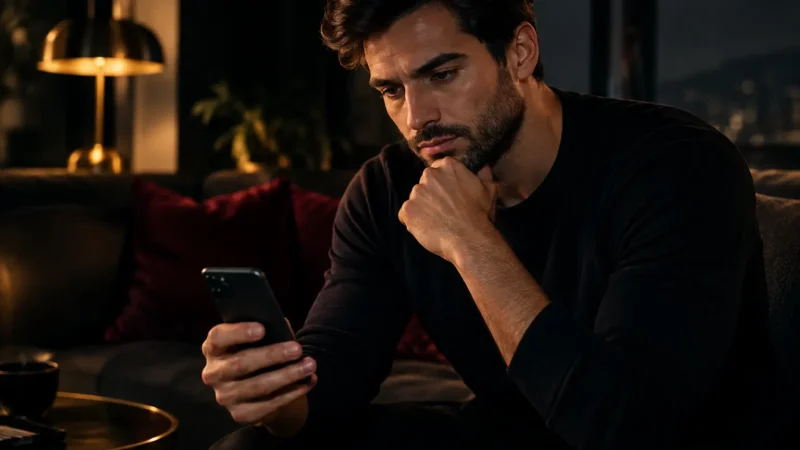
Most men do not need a better face, a professional camera, or an expensive photographer. They need to stop taking random bathroom selfies at midnight. How to take better photos of yourself comes down to three things: light, angles, and enough preparation that you are not scrambling for one usable shot.
A strong photo should look effortless. That does not mean it happened by accident. It means you controlled the variables before you hit the shutter.
Start With Light, Not Your Camera
Bad lighting will make a good-looking man look tired, pale, and awkward.
Your phone camera is already good enough. The light is what separates a clean, flattering image from a grainy photo that makes you look like you are hiding in a basement.
Shoot outdoors in open shade. Stand under the edge of a building, a covered patio, or a large tree where daylight reaches your face but direct sun does not. The best window is roughly two hours after sunrise or two hours before sunset. You get soft light, some shape in your face, and less squinting.
If you shoot indoors, face a large window. Stand three to six feet from it. Do not put the window behind you unless you want your face to become a dark silhouette. Turn off harsh overhead lights if they create deep shadows under your eyes.
Avoid three common mistakes. Do not use a car interior as your studio. Do not use the flash unless the room is almost completely dark. Do not stand directly under a ceiling light, which makes your eyes look sunken and your skin look worse.
Light should come from slightly above and in front of you. Think of it as a clean version of daylight, not a spotlight pointed at a suspect.
Use the Rear Camera and Set It Up Correctly
The front camera is convenient. Convenient is not the same as flattering.
Use your phone’s rear camera whenever possible. It usually has a better sensor, sharper detail, and less distortion. Set your phone on a tripod, shelf, bench, or stable stack of books. Camera height should sit around eye level or one to two inches above it.
Do not put the camera low and point it upward. That angle widens your lower face and makes your body look shorter. Do not place it too high either. You are taking a portrait, not filming a security camera clip.
Use the standard 1x lens on most phones. If your phone has a 2x lens, use it when you can place the camera farther away, about six to10 feet. A slightly longer lens usually makes facial proportions look more natural. Avoid the .5 wide-angle lens for close portraits. It stretches the edges of the frame and turns normal features into a cartoon.
Set a 10-second timer. Better yet, use a Bluetooth remote or your phone’s voice shutter if it works reliably. Take short video clips only if your phone captures high-quality frames. Still photos generally give you more control and cleaner results.
Clean the lens first. This takes five seconds and removes the hazy film that makes photos look cheap.
Build a Frame That Says Something About You
A blank wall can work. A messy room never does.
Your background should support the photo, not compete with it. A clean street, a coffee shop patio, a park path, a bookstore, a hotel lobby, or a simple living room with natural light all work. You do not need a luxury setting. You need order.
Before shooting, scan the edges of the frame. Remove laundry, dirty dishes, cords, cluttered counters, and anything that looks accidental. A woman may not consciously inspect every object behind you, but disorder creates an immediate impression of disorder.
Give yourself distance from the background. Stand four to eight feet in front of it if space allows. This creates depth and prevents the image from looking like a mugshot. If you are outdoors, use a background that falls away behind you, such as a sidewalk, trees, or buildings farther down the street.
Wear solid colors. Navy, charcoal, black, olive, white, and muted earth tones photograph well. Choose clothes that fit your shoulders and torso. A fitted T-shirt, overshirt, knit polo, button-down, or clean jacket is enough. Do not wear loud graphics, giant logos, or an outfit so formal it looks borrowed.
The goal is not to look rich. The goal is to look like a man who has standards when nobody is watching.
Pose Like You Are Doing Something, Not Auditioning
Trying too hard to look attractive is exactly what makes you look posed.
Do not stand square to the camera with both arms pinned to your sides. Turn your body about 30 to 45 degrees, then keep your face slightly closer to the camera. Put more weight on your back leg and let the front knee bend a little. This gives your body shape without looking theatrical.
Keep your shoulders down. Push your chin slightly forward, then lower it a fraction. This feels strange. It looks better because it defines the jaw and prevents the camera from compressing your neck.
Your hands need a job. Put one thumb in a pocket, hold a coffee cup, adjust your watch, rest a hand lightly on a railing, or carry a jacket over one shoulder. Do not clench both fists. Do not point at the camera. Do not cross your arms in every image like you are guarding a nightclub door.
Your expression should be calm. Start with your mouth relaxed, then try a slight smile that reaches your eyes. You do not need to smolder. You definitely do not need the forced, wide-eyed grin men use when they hate having their picture taken.
Take a breath out just before the shutter. That small release removes tension from your face and shoulders.
Run a 20-Minute Shoot Instead of Hunting for Luck
One photo is a gamble. Thirty controlled shots give you options.
Set aside 20 minutes. Wear one strong outfit, choose one location, and shoot with intent. Begin with a simple chest-up portrait facing open shade. Take 10 shots while making small changes: face angled left, face angled right, slight smile, neutral expression, chin a little lower.
Then shoot a three-quarter frame from mid-thigh up. Keep the camera at eye level and step back. Take another 10 shots with one hand in a pocket or holding something natural.
Finish with five to 10 candid-looking frames. Walk slowly toward the camera. Look off to the side. Sit at an outdoor table. Adjust your sleeve. The action does not need to be real. It needs to look relaxed.
Do not change everything at once. If a photo looks wrong, adjust one variable: light, camera height, body angle, or expression. Men often get frustrated because they change all four and have no idea what fixed the problem.
Review the photos on a larger screen if possible. Zoom out first. A good image works at normal size. If it only looks good after you inspect individual pores, you are overthinking it.
Edit Enough to Look Clean, Not Fake
Over-editing does not hide insecurity. It broadcasts it.
Use basic edits only. Raise brightness slightly if the image is too dark. Pull down highlights if your forehead or shirt looks blown out. Add a little contrast. Warm the temperature only if the photo looks cold and gray.
Do not reshape your jaw, smooth your skin into plastic, whiten your teeth until they glow, or use filters that change your eye color. A photo should make you look like your best rested self, not like a different man who will create confusion when you meet someone.
Crop with purpose. For a portrait, keep your eyes near the upper third of the frame. Leave a little room above your head. Do not crop at joints such as knees, elbows, or wrists. For a full-body image, show the full body and some space around it. Half-committed crops look careless.
Pick the photo where you look composed, clear, and comfortable. Not necessarily the one where you look most dramatic. Attraction responds well to a man who appears at ease in his own skin.
The useful standard is simple: if the photo looks like you on a good day, keep it. If it looks like a performance, take another one. A camera does not create presence. It only records whether you brought it.